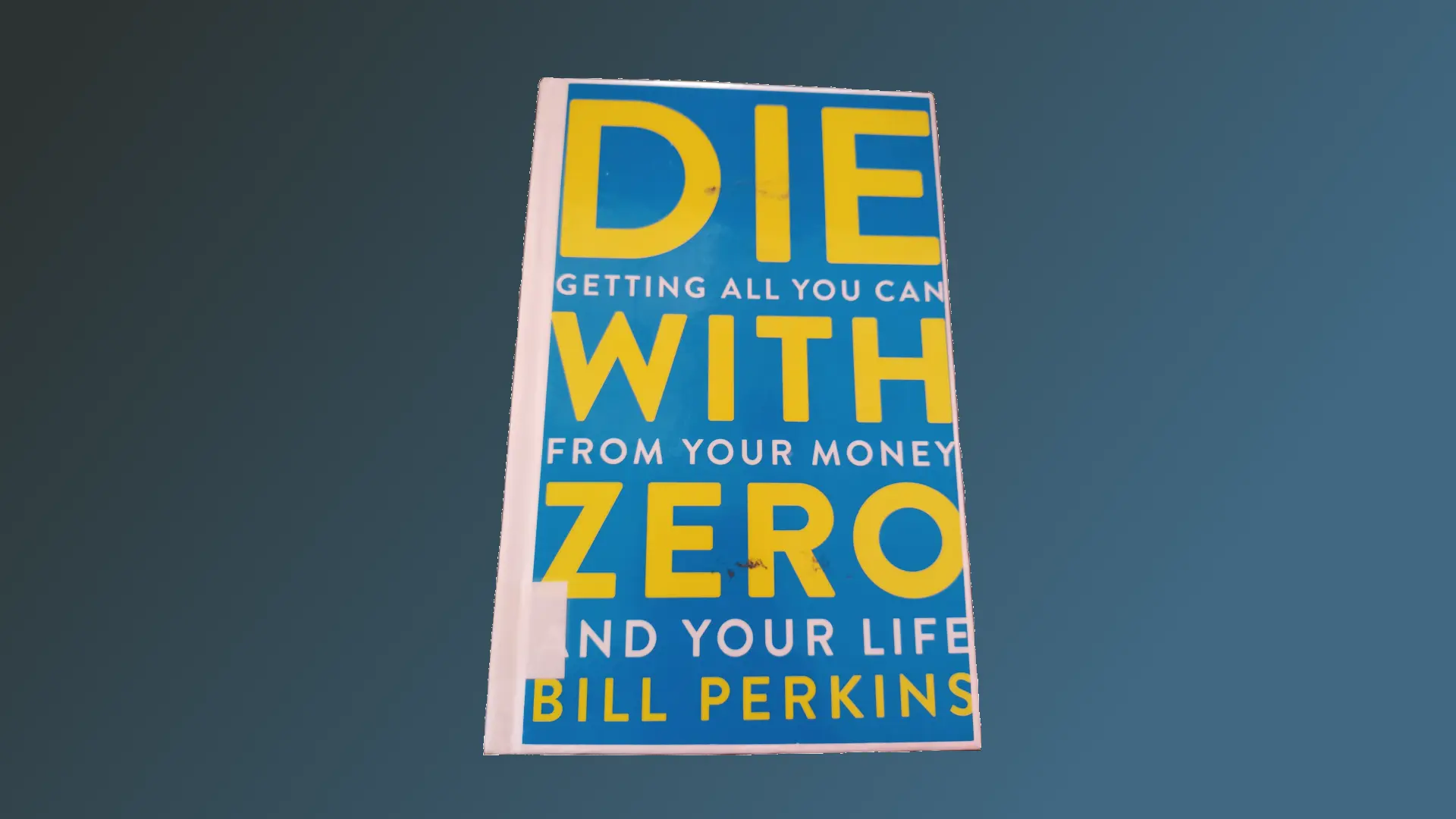
Die With Zero: Getting All You Can from Your Money and Your Life
In his book, "Die with Zero," Bill Perkins offers a fresh perspective on personal
finance, both during and after retirement. One of his most noteworthy points is that
people should favor life experiences over saving their money, considering the latter
simply a means to an end.
The first few sentences of the book immediately ask "existential" questions: "What
does he do with the inheritance? What if I get sick and need care? What about my
retirement?" These questions are enough to make any reader skeptical.
At first glance, the ideas in "Die with Zero" appear selfish, self-centered, and
most of all, risky. However, the principles presented are quite interesting and
thought-provoking, enough to make any reader question their previous financial
decisions.
“If you spend hours and hours of your life acquiring money and then die without
spending all of that money, then you’ve needlessly wasted too many precious
hours of your life.”
Choosing where and when we spend our money is the key element of the book: choosing
our spending and saving, based on what it will bring us today and tomorrow, in terms
of learning, well-being, and life experience.
We all know that there are things that we will no longer be able to do, or will be
less easy to do as we age, so why not do them when we can? If it's something
important to you, do it!
One of the striking examples mentioned in the book concerns inheritance; we all want
to leave an inheritance to our children, but the concept here is to do it at a more
opportune time. The life expectancy of Canadians is 80.7 years for men and 84.3
years for women. This means that in many cases, the inheritance will only be
distributed to descendants, when they will probably need it the least; either around
the age of 50-60, that is, when the house will be fully paid off or almost, when the
children will have finished university, when retirement is approaching…
Conversely, why not pass on part of your inheritance when your descendants will need
it most, that is to say in their 20s or 30s? when they will buy their first house,
when they will have their children… This will probably have a greater impact on
their lives!
I agree that this book offers interesting perspectives. While the premise does come
across as self-centered and risky on the surface, the ideas presented offer an
alternative way of viewing spending and saving in the broader context of life
experience. It's a fascinating thought to rethink our inheritance practices to the
benefit of our children earlier in their lives. The longevity risk is definitely
something to consider, though.
Overall, I'm interested in hearing other people's impressions of this book. Have you
read it? What did you think?